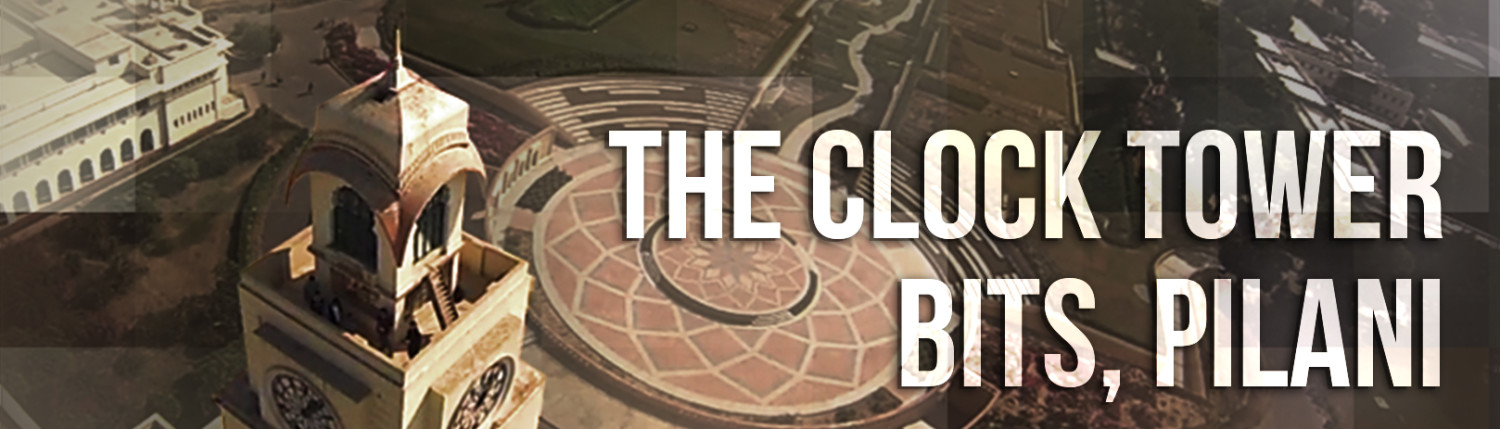

The tale of how we first embarked on this ambitious restoration task.
.
It is 2008, and a young, wide-eyed Rohit John Varghese (’08, BE Mech.) walks into BITS Pilani. Like all budding first-years, he is caught up in the heady montage of timetables, departments, interactions and try-outs. But, at the heart of the campus, something else piques this precocious teen’s interest.
The BITS Pilani Clock-Tower is unique not just with respect to its inner workings (more on that later), but the sheer inappositeness of its presence in the rustic atmosphere of rural Rajasthan. Yet, it’s somehow a perfect fit. Visible from miles and miles around, this structure is as synonymous with Pilani, as the Harvard Yard and the King’s College Chapel are with their respective institutes.
So, back in Pilani. While visiting the top-tiers of this structure was (and largely, still is) strictly forbidden, it was an open secret that a myriad group of curious younglings silently made their way up. Many stand to admire the impressive panoramic view that the tower offers, but what caught young RJV’s eyes were the curious system of bells and gears that (once) drove this then-silent leviathan.
While completing his schooling at the 150-year old Bishop Cotton Boys’ School in Bangalore, he had learned to admire the time-tested legacies and relics of the British-era. Cottons’ – as the school is popularly known – houses its own Clock-Tower, a beautiful century-old construction that has rather unfortunately fallen silent over the last many decades. At some stage, its mechanical machinations were quite tragically replaced by a more “modern electric clock”.
Fascinated by the structural mechanics and the burden of history, he hoped to ensure that Pilani’s old Tom Parr did not suffer the same fate as that of his other alma mater. But there in lay the challenge, what with the restrictions placed on students entering the inner sanctum and herculean scope of such a restoration project.
Metal Messiah
Every Butch Cassidy needs a Sundance Kid. Every Captain Kirk needs a Spock.
Similarly so, every Rohit, needs another Rohit.
In 2009, enter unto campus Rohit Carlos De Sa (‘05G, BE Mech.) a simultaneous member of the faculty and student communities. This was a position that offered him an interesting peek into both worlds. The two Rohits, as they would become famously known in Pilani circles, shared a common interest in everything mechanical (and thereabouts) and founded the Radio-Control Club in early-2011, a core group that today has representatives across various tech-teams (BAJA, Formula-Student, RoboCon et al).
One day, while discussing popular college hacks, De Sa happened to mention the antics of the graduating 2007-batch of BITS-Goans, wherein the Nescafe Duck was placed on top of their prominent B-Dome (a prank inspired by the MIT Hack of placing an actual fire-truck on top of their iconic Great Dome!).
Appreciative of the need to leave some memorable legacy before riding off into the proverbial sunset, the two considered a few interesting options before RJV mentioned his long-sustained idea of renovating the clock-tower. The encouraging response across batches to their RC Club initiative convinced this duo that setting up another ambitious project was a task worth pursuing.
Now with the burnished credentials of a faculty member, a mail was sent to the Prof. G Raghurama (Director, Pilani Campus) regarding the plans and permissions required for this ambitious project. At the subsequent meeting, they had to convincingly pitch the idea to the Director, taking into account the understandably sensitive issues surrounding personnel safety and property damage.
Eventually, with the help of the Estate Management Unit (headed by Dr. Anshuman), they were able to obtain clearance to conduct an initial study-tour of sorts. They now needed a talented photographer, who could capture all the elements within and without the structure, for proper documentation and study. Enter Rahul De (’09, BE EEE), also a former member of the BITS FSAE team. His stunning captures of the tower, its contents and the campus from atop the structure, created a repository that not only encompassed the working of the machinery, but also produced some of the most iconic photos of BITS during this time.
Armed with canisters of WD-40, hefty ropes for safety harnesses, a scraper to clean the avian blessings of generations past and their personal custom tool-belts, Hillary and Tenzing RJV and RDS began the long climb. No, really. It is a pretty long climb.
After some preliminary tests to understand the machinery better, over the next few days, they poured over the photographs (courtesy De), designed accurate sketches and models to develop a clearer picture.
Vinay Goda (‘09, BE Civil), a senior member of the FSAE Designing team helped them create a SolidWorks model for the internal clockwork, and many a long hour over the next week was spent in the library building parts and assembling them into a virtual working system.
TURN, TURN, TURN!
At this stage, quite happy with their progress so far, they went ahead with the “second” exploratory trip. Only this time, the objective was to actually create some music, so to speak.
A few hours later, members from the faculty quarters (a good mile or so away) were heard discussing whether it was the clock-tower bell they all just heard!
In their next meeting with Prof Raghurama, they showcased a zippy 3-D animation of the working machinery, as also the video recorded during their last trip that showed them manually releasing the hammer. A plan was pitched to ring the bell 41 times on the night of October 20th, 2011, marking the inauguration of Oasis – 2011 (the 41st edition of BITS Pilani’s coveted cultural festival).
In what would be remembered as one of the grandest opening ceremonies in and for a long time, the plan was perfectly carried out. As the dignitaries, which included the Directors of Goa and Hyderabad campuses, stood at D-Lawns to inaugurate the Art n’ Dee (currently the Dept. of Art, Design and Publicity) Structure, two of the bass bells began tolling – pulled by RDS and RJV. Simultaneously, a powerful green laser was shown from atop the tower, aimed at the top point of the structure, connecting the two in a bold green line against the slightly misty night sky. With so much to behold, everyone looked up in wonder at this 30-year silence suddenly breaking on an Oasis night. Say what you will, naysayers all, Oasis holds a special place in a BITSian’s heart – and that quaint night proved why it carries with it a magic that goes beyond the mere sights and sounds of a Rajasthani hamlet.
Further progress a little slow, owing to the pomp and fanfare associated with the flagging off of Project Parivartan – BITS Pilani’s massive campus-wide renovation effort. The renowned architect, Mr. Hafeez Contractor, was on campus as the creative cog in the wheel, and during a glitzy get-together, the idea of renovating this age-old tower was pitched to him by Rohit the First. While, that pitch hit an inertial stop, it goes to show that while attempting something ambitious it’s important to leave no avenue unexplored.
In the summer of 2012, the two Rohits graduated and the tower was still silent again, but they had proved an important point – that if the right forces collaborated, this old behemoth could be returned to its old glory. Before leaving, they left behind a repository of drawings and data that a future team could use to continue the good work.
Three Cool Cats
It is now mid-2013, now working in Tata Motors, RJV wondered if a BITSAA funding programme could be set up to fuel the project once again. Getting in touch with Rohit Koul (by now, it’s quite clear what’s necessary to be good at this clock business), erstwhile-CEO of BITSAA international, he managed to establish an initial rapport.
While BITSAA International could not at that time create a fund campaign because the ongoing fundraiser for BITSConnect 2.0, the discussion (a very interesting email thread, we hear!) did however help create the idea of setting up a student team again to get things going. RJV and RDS prepared a detailed proposal of the team objectives, a gospel which is still almost perfectly unchanged this far into the project.
A presentation titled – “What is inside the Clock Tower” was created to showcase their plan to the Institute administration. Over a Web-Ex discussion between the RohitsTthree and Prof Raghurama, approval was given to form a mentored student team pioneers to carry out the proposal. Dr. Anshuman (EMU) was asked to extend all possible logistical and administrative help to the on-campus team.
With a Little Help From My Friends
Enter Kartik Sunku (’09, MSc. Physics, BE Mech.), who had proven his leadership and technical skills beyond doubt with his captaincy of the BITS BAJA team. At an early stage, he was identified as the ideal candidate to the lead a fledgling team of students and coordinate closely with the off-campus Rohits.
What followed was a selection procedure to the team that would rival the placement-process of most companies that visit a technical school. An elaborate application form, requiring detailed research into clock towers and multiple essays on mechanical workings, as well as the candidate’s associations on campus, was designed. To be scrutinised closely by the senior team, this initiative attracted an overwhelming response – over a 100 students across the academic spectrum sent in their applications.
Pleasantly surprised by the quantity (and in some cases, the excellent quality!), the list was narrowed down to a core group of 13 that were called for an interview. In coordination with the BITS Embryo team, a conference call was set up at LTC Halls, with the seniors also carrying out their own due diligence for each of the candidates. While the initial plan was to recruit four students, the enthusiasm and ability on display resulted in that number quickly doubling.
With that, the original BITS Pilani Clock-Tower Restoration Team was set up, and thus began the drive to etch another marquee point in this little hamlet’s fabled history.